
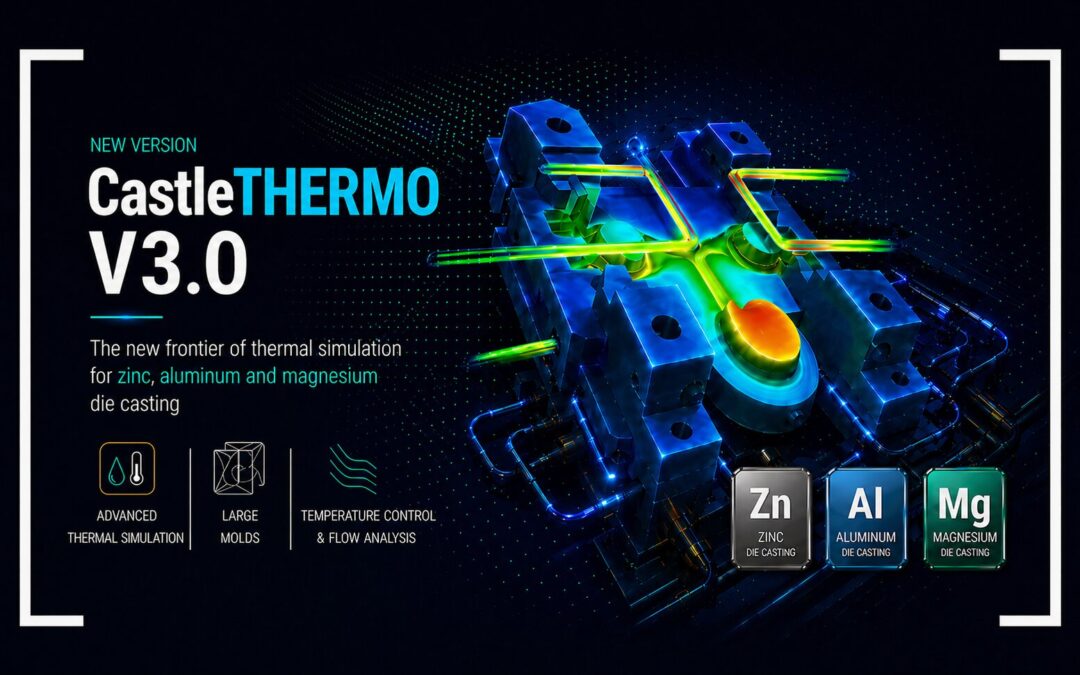
Thermal simulation applied to the world of die casting is increasingly becoming an everyday design tool. At the same time, the complexity and size of moulds continue to grow: today, giga-moulds weighing tens of tonnes and equipped with hundreds of temperature control circuits are increasingly widespread and require simulation tools that are equal to these new challenges.
It is in this context that CastleTHERMO V3.0 was created, the new version of Piq2’s thermal simulation software for aluminum, zinc and magnesium die casting, developed to make mould thermal analysis even faster, more reliable and easier to use. This is a concrete evolution designed to improve the software’s performance and usability while preserving the intuitive user experience that has always distinguished Castle.
What’s new in CastleTHERMO V3.0
Faster, more efficient and more reliable solvers
One of the main areas of development involved the core of the software: the solvers dedicated to thermal and fluid dynamics calculations have been further optimised to ensure greater speed, reliability and stability.
Particular attention has also been paid to reducing the disk space occupied by results, both during calculation and at the end of the simulation.
This approach not only reduces storage requirements, but also speeds up the visualisation of results.
New thermal analysis criteria for moulded parts
CastleTHERMO V3.0 introduces a new post-processing solver that enables the calculation and visualisation of advanced criteria for the thermal analysis of moulded parts.
The aim is no longer only to predict solidification defects in the casting, but also to identify at a glance the areas of the mould subject to the highest thermal stresses due to alloy injection or release agent spraying.
This makes it easier to identify areas that are potentially prone to deterioration, cracking or breakage, and to intervene in a targeted way on temperature control, spraying sequences, or the geometry and materials of the moulded parts.
New result visualisation
The visualisation of results has been aligned with that already available in CastleBODY, with a more modern, intuitive and customisable interface.
The new data organisation makes it easier to analyse the different phases of the cycle and provides additional results for better evaluation of both flow behaviour in the temperature control channels and the thermal load on the moulded parts.
More flexible mesh for complex models
The interface and meshing algorithms have also been revised, maintaining CastleTHERMO’s typical intuitive approach while introducing greater flexibility.
It is now possible to manage the temperature control channels’ mesh separately, enabling advanced flow calculation in the channels without excessively increasing the overall mesh size.
The result is a concrete improvement in terms of mesh size, calculation time and numerical stability.
Advanced flow calculation in temperature control channels
Thanks to a new dedicated algorithm and the specific mesh developed for the channels, CastleTHERMO V3.0 makes it possible to simulate the flow of fluid in temperature control circuits more realistically, without significantly impacting calculation times.
This brings important benefits in terms of accuracy, especially when simulating particularly complex or conformal circuits.
Improved management of temperature control circuits
To address current requirements in the design of large moulds, a more advanced management of temperature control channels has been introduced.
The classic interface is now complemented by a new tabular mode, which makes circuit configuration simpler and more intuitive, especially when the number of channels and their complexity are very high.
Pressure drop calculation in channels
One of the most significant new features in CastleTHERMO V3.0 is the introduction of a function dedicated to calculating the pressure drop between the inlet and outlet of temperature control channels.
This is a very useful tool for checking whether the flow rate defined during the design phase is actually realistic. If it is not, the software can help determine the maximum flow rate achievable with the available pump pressure, or the delivery pressure needed to reach the desired flow rate.
This feature helps address one of the main critical points in the design of cooling circuits, avoiding configurations that are theoretically correct but not feasible in practice.
Simulation of heat transfer during filling
CastleTHERMO V3.0 also introduces a new calculation phase capable of virtually simulating the effect of the intense heat transfer between the alloy and the steel that occurs in the few instants of filling.
Although this is a very brief phase, lasting only a few milliseconds, the thermal impact on the surface of the moulded parts is extremely severe and represents one of the main causes of cracking and die deterioration phenomena.
This new feature makes it possible to evaluate this effect without having to resort to a resource-intensive full filling simulation.
More flexible management of the lubrication phase
The release agent spraying phase has also been improved, with more flexible and customisable management designed to adapt even to the most articulated and complex configurations.
More advanced save timestep management
Advanced management of result save timesteps has been introduced, allowing a greater number of steps to be stored during the most thermally critical transient phases, such as the initial moments of solidification and the spraying phase.
This makes it possible to obtain a higher level of detail precisely at the moments in the cycle when the most severe thermal gradients and the most intense temperature spikes occur, while maintaining wider intervals in less critical phases in order to contain file size.
Improved management of virtual thermocouples
The new version also improves the management of virtual thermocouples, offering the possibility to export data and reprocess it externally in spreadsheets.
This practical advantage further simplifies result analysis and the sharing of information with the technical team.
A new step forward for thermal simulation in foundries
With CastleTHERMO V3.0, thermal simulation takes an important step forward for all professionals in aluminum, zinc and magnesium die casting.
The new version has been developed to respond concretely to the needs of designers, process engineers and foundry specialists who have to deal with increasingly large, complex and high-performance moulds, providing more advanced tools to improve simulation reliability, optimise temperature control, reduce calculation times and analyse the most critical thermal phenomena with greater precision.
The improvements introduced are particularly relevant for giga-moulds and the most advanced configurations, but they also bring tangible benefits to the design and simulation of traditional moulds.
CastleTHERMO V3.0 is the ideal solution for those who want to take mould thermal simulation to the next level, improve the quality of the die casting process and turn production complexity into a concrete competitive advantage.